Quick answer
The Prague to Vienna route's hidden gems include: the Renaissance wine town of Mělník at the Vltava-Elbe confluence, the fairy-tale moated castle at Červená Lhota in South Bohemia, the underground wine labyrinth of Znojmo in Moravia, and the tiny fortified town of Retz in Austria's Weinviertel. Most cyclists cycle past all of these without stopping.
Who is this for
This guide is for cyclists who have already looked up the main Prague–Vienna highlights — or who are on the route now — and want to know what's worth a detour or a longer stop. It focuses deliberately on places that aren't mentioned in the first page of search results and that most tour operators don't include in their route notes.
Czech section: Prague to the Moravian border
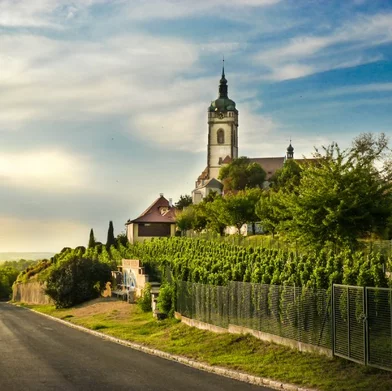
Mělník — the wine bluff above the river confluence
Mělník sits on a promontory above the point where the Vltava flows into the Elbe — the exact confluence visible from the castle terrace. Most cyclists glance at the view and keep moving. What they miss: the town's Renaissance chateau has one of the most interesting wine cellars in Bohemia, directly beneath the castle walls, where Mělník's distinctive Pinot Noir and Riesling are aged. The chateau family (the Lobkowicz family, whose collections were confiscated by Communists and restored after 1989) gives vineyard tours. The castle wine shop sells bottles you won't find anywhere else. It's worth 90 minutes.
Kokořín — the valley of forgotten castles
A small detour north of the Elbe, the Kokořínsko protected landscape area is a sandstone canyon country of hidden valleys, ruined medieval towers, and a remarkably preserved 14th-century castle that looks like it belongs in a fairy tale. The cycling detour adds 30–40 km and some climbing to the main route, but the valley roads are car-free and the landscape is extraordinary. Almost no foreign tourists. Combine with an overnight in Mělník.
Třeboň — Renaissance spa town in the fish pond landscape
South Bohemia's Třeboň (Wittingau in German) is one of the least visited UNESCO-adjacent towns in Czech Republic despite being genuinely excellent. The old town — ringed by its original medieval walls — is almost perfectly preserved Renaissance. The Schwarzenberg family's Renaissance chateau dominates one end; the famous thermal spa is at the other. The surrounding landscape of medieval fish ponds and reed beds (still commercially harvested, producing roughly 70% of Czech freshwater fish production) is biologically extraordinary — the autumn fish harvest, when enormous nets are drawn across the ponds, is one of the great spectacles of rural Central Europe and draws locals from across South Bohemia every October.
Červená Lhota — the red castle on the water
One of the most photographed but least visited castles in Bohemia. Červená Lhota is a small Renaissance chateau built on a rock in the middle of a forest pond, connected to the shore by a narrow causeway. Its red-painted walls reflected in the still water create an image that looks almost too picturesque to be real. It's a small detour from the main south-bound route toward Třeboň, and the castle interior (Habsburg furnishings, period costumes, guided tours in Czech with optional English) is less important than the exterior view from the causeway. A ten-minute stop that produces the best photograph of the entire trip.
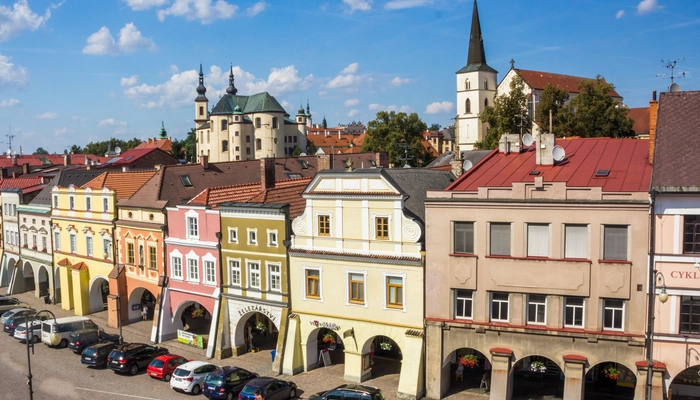
Telč — the square that stopped time
A UNESCO World Heritage Site that somehow remains relatively uncrowded. Telč's main square is a perfectly preserved 16th-century Renaissance townscape — a long rectangular piazza lined with arcaded houses, each slightly different in gable style and colour, their reflections in the surrounding fish ponds completing the picture. The chateau at one end is excellent. This requires a detour east of the main route but is reachable by train from Jihlava — combine with an overnight and treat it as a deliberate rest day.
Moravian section: Czech wine country
Vranov nad Dyjí — the chateau above the gorge
Below Znojmo, the Thaya/Dyje river cuts a dramatic gorge through the South Moravian upland before reaching the Austrian border. Vranov nad Dyjí is a Baroque chateau perched on a cliff above the gorge — the view from the terrace down into the river 100 metres below is one of the finest in Moravia. The surrounding Podyjí national park is excellent for hiking and the local wine (Znojmo denomination) is produced within walking distance of the castle. Almost no foreign visitors; mostly Czech weekenders from Brno.
Znojmo's underground — the city beneath the city
The historic centre of Znojmo sits on a plateau above the Dyje river, but beneath it is something extraordinary: a network of underground wine cellars, storage tunnels, and escape routes carved from the sandstone over five centuries, totalling over 27 km of tunnels connecting virtually every cellar in the old town. Guided tours descend several storeys into the rock and wind through chambers where barrels of Znojmo wine still age in the cool silence. The tour takes about 45 minutes and ends with a tasting. It's cheap, uncrowded, and completely different from anything else on the route.
Šobes vineyard — the Danube bend vineyard that isn't on the Danube
In the Podyjí national park below Znojmo, a loop of the Thaya river encloses a south-facing peninsula that has been planted with vines since at least the 11th century. The Šobes vineyard — cultivated by a Znojmo winery — produces wine from one of the most unusual and photogenic vineyard sites in Central Europe: steeply terraced rows facing the river bend, accessible only by a narrow track through the national park. Cyclists can ride to the vineyard via the park's cycle routes and look down at the vines from the park boundary. The wine is available in Znojmo.
Austrian section: Weinviertel
Retz — the wine town with the underground cellar town
Just across the Austrian border, Retz is one of Lower Austria's finest small towns — a Renaissance market square surrounded by the towers of a historic grain-storage windmill, surrounded in turn by vineyards. But Retz's real secret is underground: the town sits on a 13 km network of wine cellars carved from sandstone, connecting virtually every house in the old town to the communal cellar system. The guided cellar tour (in German and English) descends 16 metres, passes through cathedral-like vaulted chambers, and ends in a tasting room lined with the local Grüner Veltliner and Riesling. It's the Austrian equivalent of Znojmo's underground — and most Prague–Vienna cyclists cycle straight past without knowing it exists.
Mailberg — the Knights of Malta castle in the vineyards
Five kilometres north of Pulkau in the Weinviertel, the small village of Mailberg has an 11th-century castle that has been continuously occupied by the Knights of Malta since the 13th century. It now functions as a wine estate — the Knights of Malta produce wines from the surrounding vineyards and operate a small guest house in the castle outbuildings. Visiting requires planning ahead (call ahead for cellar tastings), but cycling past a working Knights of Malta castle that makes wine is an experience difficult to replicate anywhere else in Europe.
Laa an der Thaya — the forgotten medieval town
Close to the Czech border, Laa an der Thaya is a quiet Weinviertel town with a beautifully preserved medieval core, an intact castle, and the most remarkable beer garden in Lower Austria — the local Laaer Bier has been brewed here since the 14th century and the brewery's garden occupies the castle courtyard. Most Prague–Vienna cyclists miss this entirely because it sits slightly west of the most direct route. Worth a lunch stop.
How to build these into your route
Most of these gems require only a short detour or an extra 30–60 minutes at a stop. A few (Telč, Kokořín) require an overnight or a deliberate day-off decision. The best approach:
- Before departure, identify two or three that match your interests and pre-plan a slight route adjustment
- Don't over-program — leave one day open to follow signposts to something unexpected
- Ask guesthouse owners what's worth visiting locally — they often know the single best thing to see that no guidebook mentions
When to go
Most of these sites are best in May–June (everything open, daylight long) and September–October (harvest atmosphere in Moravia and the Weinviertel, autumn light in the Czech forests). Červená Lhota and Třeboň are particularly beautiful in May when the surrounding water reflects spring light. Znojmo's underground is best in July–August when the contrast between the hot surface and cool tunnels is most dramatic.
Practical tips
- Červená Lhota castle opens at 9am in season — visit early before tour groups arrive by minibus
- Znojmo's underground tour must be booked ahead in July–August — call the tourist office or book via their website
- Retz's cellar tour runs on a fixed timetable — check the current schedule at the tourist office on arrival
- Mailberg's castle winery requires advance contact for tastings — worth arranging before departure
- Telč is easiest reached by train from Jihlava — leaving your bike at the station and taking the train for a rest day works well
Recommended tours
Our self-guided Prague–Vienna tours can be customised to include detours and overnight stays in some of the places described here. Talk to us about adjusting your itinerary to include Třeboň, Znojmo's underground, or an overnight at Retz. Browse our Prague–Vienna listings to start planning.