Quick answer
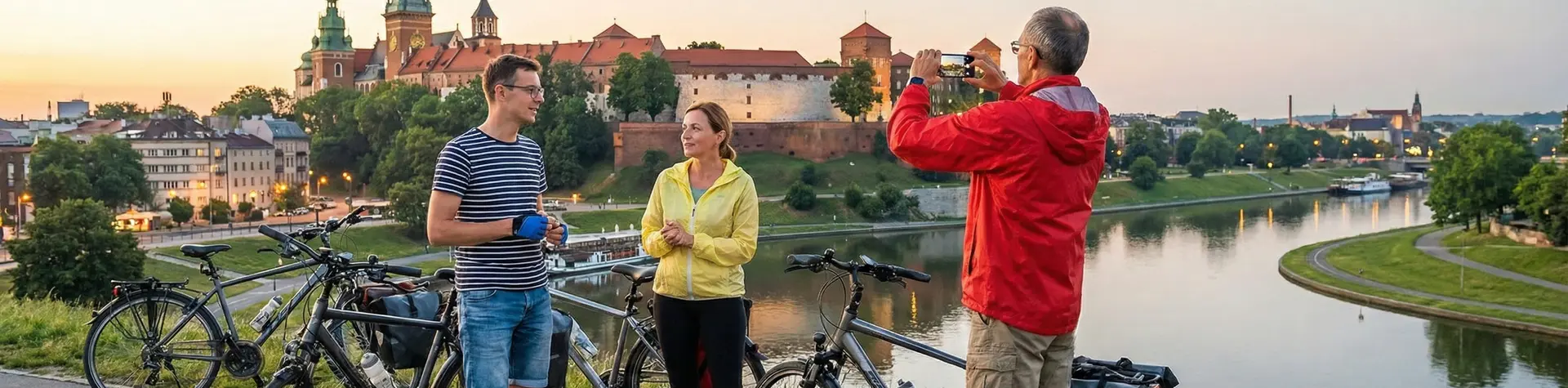
The Elbe Cycle Path is a long, mostly flat riverside route through the heart of Central Europe. The classic holiday section — Prague or Dresden to Hamburg — takes 10–14 days and combines historic cities, quiet Saxon countryside, and Germany's iconic river landscapes. It's not as dramatic as the Danube's Wachau gorge, but it rewards you with space, solitude, and a feeling of genuine journey.
Who is this for
The Elbe Cycle Path suits cyclists who enjoy long, relaxed days in the saddle with plenty of cultural stops and the satisfaction of watching a landscape slowly change over hundreds of kilometres. It's particularly popular with German and Dutch cyclists, and less internationally marketed than the Danube — which means quieter paths, more local character, and less competition for hotel beds in July.
Is the Elbe cycle path boring?
This is the most common question from cyclists considering the route — usually from people who've heard it compared unfavourably to the Danube or Rhine. The honest answer: parts of it are quiet and wide-open in a way that some cyclists love and others find monotonous. The middle section between Wittenberg and Magdeburg passes through the flat, agricultural heartland of former East Germany — wide river, big skies, sparse villages, and long stretches without a coffee stop.
But calling the Elbe boring would be unfair. Dresden is one of the most architecturally remarkable cities in Europe. The Saxon Switzerland section near Bad Schandau — where the Elbe cuts through dramatic sandstone formations — is genuinely stunning. Meissen has a fairy-tale hilltop castle and the oldest porcelain manufactory in Europe. And Hamburg is one of the continent's great port cities. The route earns its reputation as much through atmosphere and scale as through dramatic scenery.
Route overview
Prague to Dresden (~170 km, 2–3 days)
This section follows the Elbe upstream into the Czech Republic, or downstream if you're starting in Prague. The Czech stretch is less developed for cycle tourism than the German section — waymarking is patchier and accommodation options thinner — but the scenery rewards the extra planning effort. The Elbe cuts through the Elbe Sandstone Mountains (Elbsandsteingebirge), a national park shared between Germany and the Czech Republic, where table-top rock formations tower above the river. The crossing at Bad Schandau is the gateway to the dramatic heart of the German section.
Dresden to Meissen (~25 km)
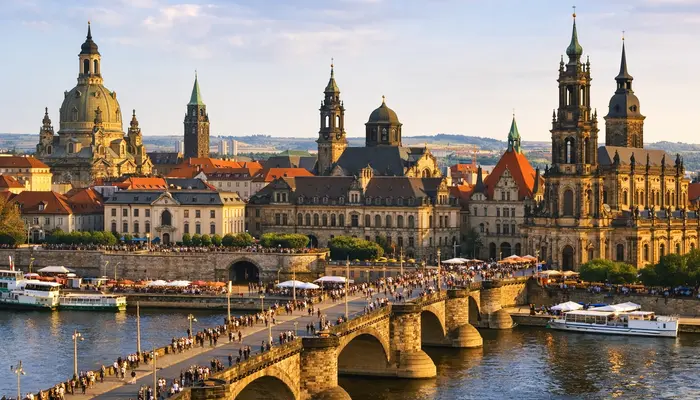
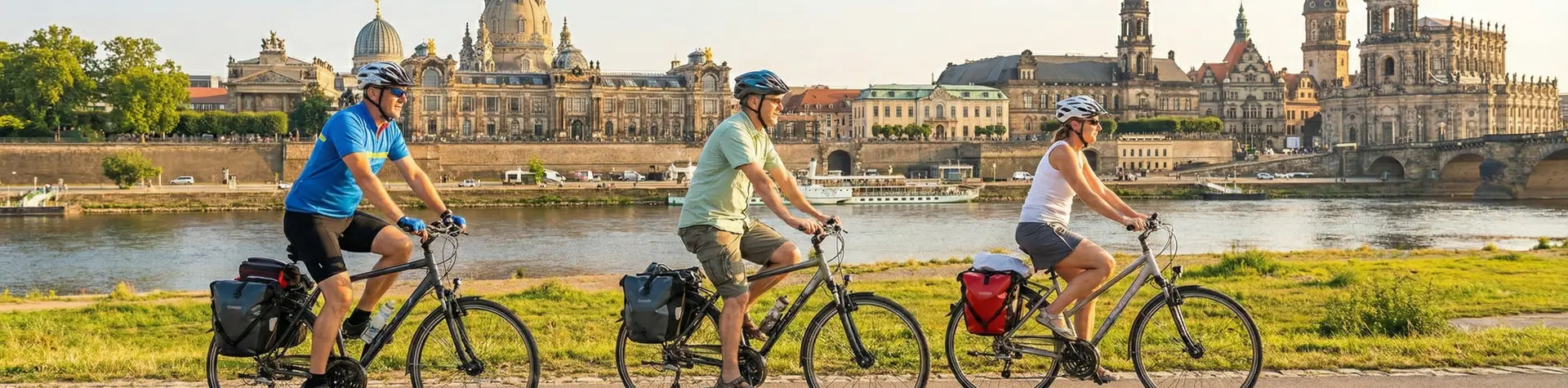
Dresden is the route's undisputed cultural centrepiece. The Baroque skyline — the Frauenkirche, the Semperoper, the Zwinger — was almost entirely rebuilt after wartime destruction and stands today as one of Germany's most photogenic cities. Budget a full rest day. From Dresden the path follows a pleasant section of the river to Meissen, the small city famous for its blue-and-white porcelain. The hilltop cathedral and Albrechtsburg castle are worth the climb.
Meissen to Wittenberg (~250 km, 4–5 days)
This central section passes through the broad Saxon and Saxony-Anhalt countryside. Highlights include Torgau, a Renaissance town with a castle above the river, and the historic town of Wittenberg (officially Lutherstadt Wittenberg), where Martin Luther posted his 95 Theses in 1517. The landscape here is flat and agricultural — wide fields, poplar-lined dykes, and the big river rolling quietly alongside. Cycle path surfaces vary: some excellent asphalt, some rougher compacted gravel.
Wittenberg to Magdeburg (~100 km, 1–2 days)
The Elbe widens here and the floodplain becomes more expansive. Dessau, home of the original Bauhaus design school, is a worthwhile detour for architecture enthusiasts. Magdeburg is an underrated city with a fine cathedral, a rebuilt old town, and a lively waterfront.
Magdeburg to Hamburg (~250 km, 3–4 days)
The lower Elbe passes through the Elbe Biosphere Reserve, a UNESCO-listed area of meandering channels, oxbow lakes, and flood meadows. The landscape becomes wilder and more bird-rich. The final approach into Hamburg along the broad tidal river, past the docks and container terminals, is unexpectedly moving — the sudden arrival of a major port city after days of quiet countryside creates a satisfying sense of arrival. Hamburg's Speicherstadt warehouse district and the Reeperbahn are the obvious celebrations at the journey's end.
Terrain and difficulty
The Elbe Cycle Path is predominantly flat. The major exceptions are the Saxon Switzerland section near Bad Schandau (short but significant climbs between the river and the plateau above) and the Czech section above Prague. The German section from Dresden to Hamburg involves very little climbing — the river gradient is gentle and the path stays close to the water. Total elevation gain Dresden to Hamburg is under 600 metres across roughly 600 km.
The main physical challenge is distance rather than difficulty — multi-day efforts in the saddle at 60–80 km per day require fitness and a comfortable bike more than technical ability.
Distances and suggested daily stages (Dresden to Hamburg)
| Day | From | To | Distance |
|---|---|---|---|
| 1 | Dresden | Meissen | ~25 km (short — Dresden rest day recommended) |
| 2 | Meissen | Riesa | ~50 km |
| 3 | Riesa | Torgau | ~55 km |
| 4 | Torgau | Wittenberg | ~60 km |
| 5 | Wittenberg | Dessau | ~50 km |
| 6 | Dessau | Magdeburg | ~55 km |
| 7 | Magdeburg | Tangermünde | ~50 km |
| 8 | Tangermünde | Wittenberge | ~65 km |
| 9 | Wittenberge | Lauenburg | ~75 km |
| 10 | Lauenburg | Hamburg | ~50 km |
When to go
May to September is the cycling season on the Elbe. The route is at its best in May and June when the river meadows are green and flower-filled and the days are long without yet being oppressively hot. August is peak season on the German section — paths can feel busy around Dresden and the campsites fill up. September is excellent — harvest time, fewer cyclists, and warm days with cooler evenings. Avoid spring flooding: the Elbe's floodplain sections can be underwater in March–April during snow melt years, sometimes closing path sections.
Practical tips
- The German Elberadweg app provides offline maps and current path closures — worth downloading before you go
- Path surface quality is inconsistent: some sections are smooth asphalt, others compacted gravel or sand. Tyres of at least 35mm are strongly recommended
- Ferry crossings (Fähren) link the two banks at regular intervals — some run on limited timetables, so check before planning your day around them
- Between Wittenberg and Magdeburg, services are sparse — plan your food and water supply
- The Saxon Switzerland section requires a physical map or GPS — waymarking through the national park is less consistent
- Bring a small German phrasebook — English is less widely spoken in rural Saxony-Anhalt than in the cities
- Hamburg is expensive — book accommodation in the city well in advance
Recommended tours
We offer guided and self-guided tours covering the Elbe Cycle Path from Prague or Dresden to Hamburg. Luggage transfer, vetted cycling-friendly accommodation, and detailed daily route notes are included. See our tour listings for the full itinerary and pricing.