Quick answer
The unmissable sights on the Elbe Cycle Path are the Saxon Switzerland National Park (dramatic sandstone rock formations in Germany), Dresden (one of Europe's greatest baroque cities), Meissen (the hilltop medieval city famous for porcelain), and the Děčín Castle in Czech Republic. The most scenic single day on the route is cycling through the Saxon Switzerland gorge between Hřensko and Pirna.
Who is this for
This guide is for cyclists planning the Elbe Cycle Path from Prague toward Dresden or Hamburg, and for anyone wondering which stops on this long route are worth slowing down for.
The route overview
The Elbe Cycle Path (EuroVelo 30) runs from the river's source in the Czech Giant Mountains (Krkonoše) all the way to Cuxhaven on the German North Sea coast — over 1,200 km in total. The most popular section for touring cyclists starts in Prague and ends in Dresden or Hamburg.
| Section | Distance | Highlights |
|---|---|---|
| Prague to Czech–German border | ~130 km | Mělník, Litoměřice, Děčín, Hřensko |
| Czech border to Dresden | ~60 km | Saxon Switzerland, Pirna, Dresden |
| Dresden to Magdeburg | ~260 km | Meissen, Wittenberg, Dessau |
| Magdeburg to Hamburg | ~250 km | Tangermünde, Boizenburg |
The Prague–Dresden section is the most dramatic and most commonly ridden by Central European cycling tourists. This guide focuses primarily on this section, with notes on highlights further downstream.
Mělník — wine above the confluence
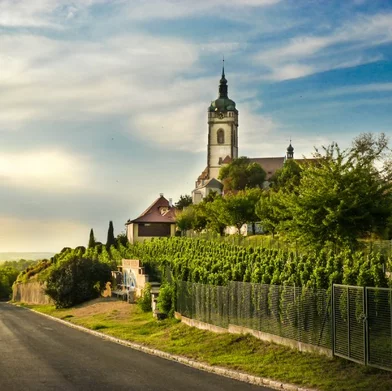
The first significant stop north of Prague, Mělník sits dramatically above the confluence of the Vltava and Elbe rivers — the point where the Vltava ends and the Elbe begins its journey to the North Sea.
The town is dominated by a Renaissance château (now a wine estate — tours and tastings available) perched on the cliff above the rivers. The views from the château terrace over the confluence and the flat Bohemian plains stretching north are extraordinary. Mělník produces Bohemia's best red wines (Ludmila, a Pinot Noir blend) — a tasting stop here is entirely justified.
Distance from Prague: ~35 km. Ideal for a morning ride and lunch before continuing north.
Litoměřice — Bohemian baroque at its best
One of the most underrated towns on the Czech section, Litoměřice has a beautifully preserved baroque town center that sees relatively few foreign tourists compared to Prague. The main square (Mírové náměstí) is one of the most elegant in Bohemia, ringed by pastel-colored baroque facades.
The town sits in the heart of Czech wine country — the warm, sheltered slopes along the Elbe here produce crisp Riesling and aromatic Müller-Thurgau. Local wine shops along the main square sell bottles at very reasonable prices.
Distance from Mělník: ~30 km. Typically a lunch or first-night stop.
Terezín — a solemn and important detour
Terezín (Theresienstadt) is just 3 km off the Elbe path and warrants a detour for its profound historical significance. The 18th-century fortress town was used as a Nazi concentration camp and ghetto during World War II. The Terezín Memorial — including the Small Fortress (Malá pevnost) and the Ghetto Museum — is one of the most important Holocaust memorial sites in Central Europe.
This is not a typical sightseeing stop, and visitors should allow 2–3 hours to do it justice. The experience is sobering and important — many cycling tourists describe it as the most meaningful stop on the entire route.
Děčín — the last Czech city and its castle
Děčín is the last major Czech city before the German border. Built where the Elbe cuts through a narrow gorge between steep hills, the city has a dramatic setting and a castle (Děčínský zámek) perched on a rocky promontory above the river with views that stretch for kilometers in both directions.
The Shepherd's Wall (Pastýřská stěna) — a rose garden terraced down a steep hillside, accessible by historic funicular — is an unexpected delight and gives you elevated views over the river and the town below.
Děčín is typically a first-night stop for cyclists starting in Prague and heading toward Dresden.
Hřensko and the Czech-Saxon border
Hřensko is a tiny village in a dramatic canyon where the Elbe cuts through the Bohemian-Saxon sandstone plateau at the Czech-German border. The scenery here changes abruptly — the rolling Bohemian hills give way to towering sandstone cliffs and deep forested gorges.
The village itself is a cluster of half-timbered houses wedged between the cliff faces and the river — it looks almost too picturesque to be real. From here, you cross into Germany and enter the Saxon Switzerland National Park.
Saxon Switzerland National Park — the route's scenic climax
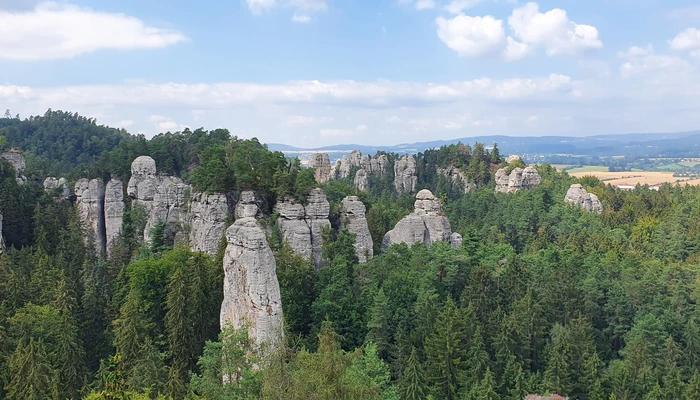
The 30 km section from Hřensko to Pirna through the Saxon Switzerland National Park (Sächsische Schweiz) is the most dramatic cycling of the entire Elbe route. The Elbe here flows through a deep sandstone gorge, the rock faces rising vertically from the riverbank, carved by millennia of erosion into extraordinary formations.
Key highlights within the park:
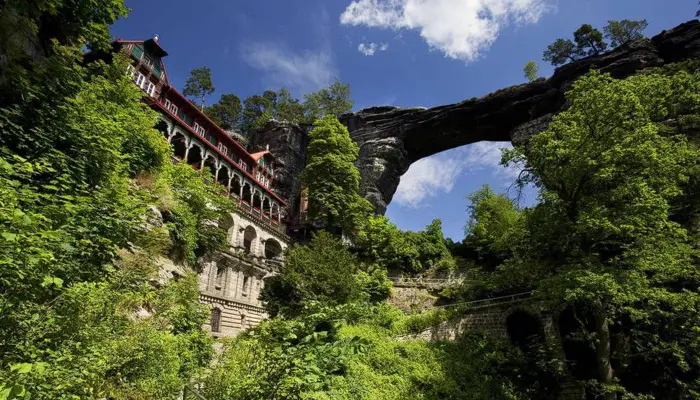
- Bastei rock formation — the signature image of Saxon Switzerland; an ancient bridge connects towering sandstone pillars 190 meters above the Elbe. Visible from the valley path, or accessible by a short but steep hike (highly recommended)
- Königstein Fortress — a vast hilltop fortress that was never captured in battle; it looms above the river for several kilometers of cycling. Tours of the interior are fascinating
- Bad Schandau — a charming spa town with thermal baths, elegant 19th-century hotels, and a historic water-powered lift (Personenaufzug) that climbs the cliff face to hiking trails above
- Rathen — the village directly below the Bastei, reached by a short ferry across the river; the base for the hike to the rock formations
Allow a full day for this section — the scenery demands it, and rushing would be a waste.
Pirna — the gateway to Dresden
Pirna marks the end of the national park and the beginning of the Dresden urban area. The old town has a well-preserved medieval center with a notable Late Gothic church (Marienkirche) and a pleasant market square. Many cyclists use it as an overnight base for visiting Dresden (15 km by bike or S-Bahn train).
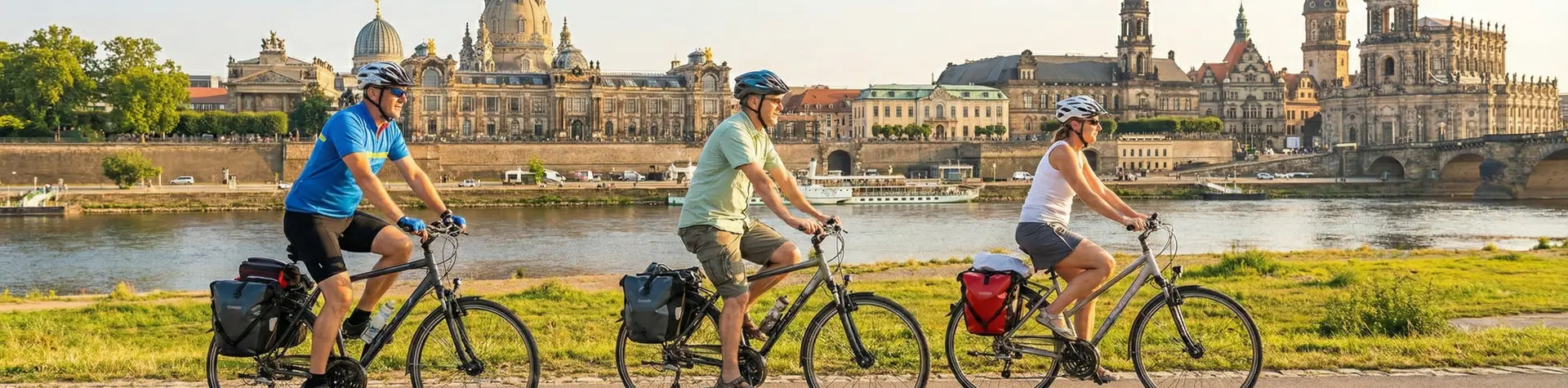
Dresden — the baroque capital
Dresden is the destination that justifies the entire Czech section of the Elbe Cycle Path. The city was catastrophically bombed in February 1945 and spent decades in decay under East Germany, but since reunification it has been restored to something approaching its historic glory — and in some ways surpassed it.
Key sights:
- Frauenkirche — the rebuilt baroque church, destroyed in 1945 and meticulously reconstructed stone by stone after reunification. Inside is magnificent; the view from the dome over the city is the best available
- Zwinger Palace — one of Europe's finest baroque pleasure palaces, housing the Old Masters Picture Gallery (Raphael's Sistine Madonna is here) and the porcelain collection
- Brühl's Terrace — the elevated terrace along the Elbe embankment, with views over the river and the vineyard hills across the water; historically called the "Balcony of Europe"
- Neustadt district — the hip, lively neighbourhood north of the Elbe with independent restaurants, craft beer bars, and a very different energy from the baroque museum quarter
- Semperoper — one of the world's great opera houses; even a quick look at the exterior is worthwhile
Dresden deserves at least two nights — one for the historic center, one for the Neustadt and the suburbs. Cycling in the city is easy and well-supported.
Meissen — medieval hilltop city and porcelain
If you're continuing beyond Dresden, Meissen (25 km downstream) is the next unmissable stop. The Albrechtsburg castle and Dom cathedral sit side by side on a rocky hill above the river in the most picturesque possible composition. The city below is compact, medieval, and almost entirely free of the mass tourism that affects Dresden.
Meissen porcelain — the original European hard-paste porcelain, invented here in 1708 — is still produced at the factory on the riverbank. The museum and factory tour are genuinely fascinating, especially if you arrive to see the artists hand-painting individual pieces.
Wittenberg — reformation history
Further downstream (roughly 2 days from Dresden), Wittenberg is where Martin Luther nailed his 95 Theses in 1517 — the spark that ignited the Reformation. The town's historic center is a UNESCO World Heritage Site, and the Reformation history is presented at multiple sites with real depth and quality. It's not just for history buffs — the town is handsome and compact, and the cycling approaching along the Elbe through flat Saxon countryside has its own quiet appeal.
When to go
The Czech section of the Elbe path is best from May to September. The Saxon Switzerland is spectacular in all seasons, but paths can be icy and services limited outside summer. May is particularly beautiful — the forests are bright green and wildflowers cover the meadows. Autumn (September–October) brings golden foliage to the Saxon gorge and is arguably the most atmospheric time for photography.
Practical tips
- The path crosses between Czech and German bank regularly — signage is generally excellent, but download offline maps as backup
- In Saxon Switzerland, some riverside sections require pushing the bike on steep or narrow stretches — this is normal and worth it
- The ferry crossings in the national park are part of the experience (and the only way to reach some villages) — they're frequent and cheap
- Dresden's old town is busiest on summer weekends — arrive Friday evening or Monday morning for a quieter experience
- Use Mapy.cz for the Czech section; komoot or Bikeline GPS for the German section
- The Elbe path sometimes floods in spring — check current conditions before setting off if traveling April–May
Recommended tours
We offer a self-guided Prague to Dresden cycling tour along the Elbe, covering the most scenic section of the route through Děčín, the Saxon Switzerland National Park, and finishing in Dresden. Accommodation, luggage transfer, and route notes are all included — you just ride and explore.