Quick answer
The most scenic cycling routes in Central Europe are the Wachau Valley on the Austrian Danube, the Elbe Sandstone Mountains (Saxon and Bohemian Switzerland) on the German-Czech border, and the Hungarian Danube Bend north of Budapest. Each offers genuinely dramatic landscape that rivals anything in Western Europe — with the added benefit of fewer tourists and lower prices.
Who is this for
This guide is for cyclists who choose their routes based on scenery first and logistics second — who want to know which stretches of the Central European cycling network will take their breath away, rather than which are the best signed or most serviced. The routes below are ranked by visual impact and cycling experience quality.
1. Wachau Valley, Austria (35 km)
The undisputed number one. The Wachau is a narrow gorge carved by the Danube through the eastern foothills of the Alps, UNESCO-listed for its extraordinary combination of natural and cultural landscape. On both banks, terraced vineyards climb steeply above the water; ruined and inhabited castles crown every defensible promontory; apricot orchards fill the flatter ground between the vines. Medieval market towns — Spitz, Dürnstein, Weißenkirchen — are spaced at perfectly human intervals along the north bank. The cycling path follows the river so closely that in places the water is immediately below your wheels. No other 35 km of cycling in Central Europe concentrates this much beauty.
Access: Melk and Krems are both reachable by direct train from Vienna (1–1.5 hours). The section is a natural day out or overnight from the city.
2. Elbe Sandstone Mountains / Saxon & Bohemian Switzerland (60 km)
The most surprising landscape on the Central European cycling map. The Elbe Cycle Path between Bad Schandau (Germany) and the Czech border passes through a national park where the river has carved through a plateau of soft Elbe sandstone, leaving a forest of table-top mesas, vertical rock towers, and dramatic cliff faces that rise hundreds of metres above the water. The Bastei viewpoint — accessible by a short detour from the path — offers one of the most photographed vistas in Germany: a cluster of sandstone spires with the river far below and the Czech hills beyond.
On the Czech side (Bohemian Switzerland), the formations continue and become even wilder — the Pravčická brána, the largest natural rock arch in Europe, is a short hike from the river near Hřensko. The entire zone feels genuinely remote and primordial despite being within day-trip distance of Dresden and Prague.
Access: Dresden is the natural base; Bad Schandau is reachable by S-Bahn from Dresden in 45 minutes.
3. Hungarian Danube Bend (Dunakanyar) (80 km)
The point where the Danube makes its dramatic right-angle turn through forested Hungarian hills. The Dunakanyar is Hungary's most celebrated scenic region — a landscape of sharp bends, forested hillsides dropping to the water, and a string of historically rich towns perched above the river. Esztergom's basilica, the largest church in Hungary, sits on a promontory with Slovakia visible just across the water — an extraordinary sight from the cycle path below. Visegrád commands the bend's tightest point from a medieval citadel high above the river. Between them, the valley is as close to pristine as the Danube gets in Central Europe. Less known than the Wachau but genuinely spectacular in a wilder, less manicured way.
Access: Both start and end points (Esztergom and Szentendre) are reachable by bus and train from Budapest.
4. Vltava Valley: Prague to Český Krumlov (170 km)
The Vltava south of Prague winds through rolling Bohemian hills in a series of tight meanders — a landscape that gradually intensifies as the river narrows and the hills steepen. The endpoint, Český Krumlov, is one of the most perfectly preserved medieval towns in Europe: a castle town wrapped around a dramatic horseshoe bend of the river, its Renaissance and Baroque buildings virtually unchanged since the 17th century. The cycling between Prague and Český Krumlov passes through less-visited Bohemian countryside — quiet, green, and genuinely rural. The approach to Český Krumlov, catching the castle tower above the treetops as the path rounds the last bend, is one of the most satisfying arrival moments in Central European cycling.
Access: Fly into Prague; return by bus from Český Krumlov to Prague (3 hours). A natural 3–4 day route.
5. Wipp Valley and Inn Valley, Tyrol, Austria
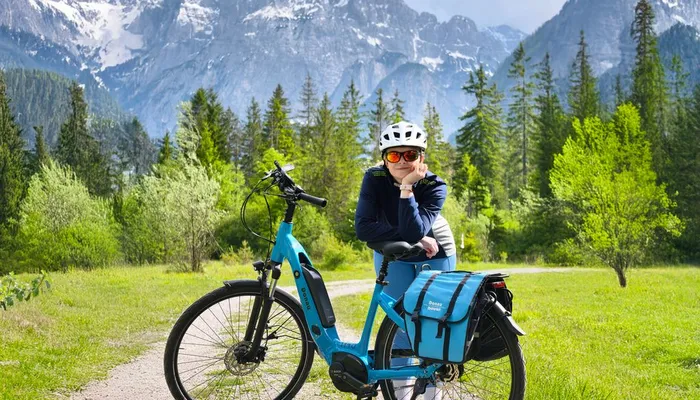
For cyclists who want Alpine mountain scenery rather than river gorge scenery, the Inn Valley through the Austrian Tyrol is the choice. The valley floor is flat enough for comfortable cycling, but the walls rise to 2,000–3,000 m above on both sides — permanently snow-capped peaks, cable-car pylons, and the dramatic scale of Alpine architecture visible from the saddle. Innsbruck itself, sitting in the valley floor with peaks visible from every street, is one of the most dramatically sited cities in the Alps. The valley cycling east and west from the city is extraordinary in good weather.
Access: Innsbruck is served by direct trains from Vienna, Munich, and Zurich.
6. South Moravian Wine Hills, Czech Republic
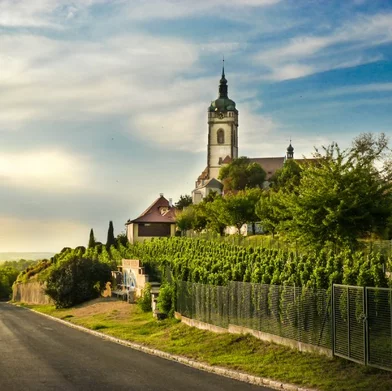
The rolling wine country of South Moravia — below Znojmo and extending toward the Austrian border — is Central Europe's most underrated cycling landscape. The hills are gentle enough to be comfortable but varied enough to keep the riding interesting; the vineyards are intensively cultivated and the cellars open for tasting; the villages are preserved in a warm, southern style that owes more to Austria and Hungary than to the Czech interior. The Pálava protected landscape area, where dramatic limestone bluffs rise from the Thaya/Dyje river floodplain, is the scenic centrepiece — a landscape that genuinely surprises first-time visitors who expect flat Central European farmland.
Access: Brno, the Moravian capital, is the nearest city hub (1.5 hours from Prague by train). Znojmo is reachable by bus or train from Brno.
7. Elbe between Meissen and Torgau, Saxony
Less dramatic than the Sandstone Mountains section, but quietly beautiful in a way that accumulates over distance. The Saxon Elbe between Meissen and Torgau passes through a landscape of river meadows, poplar dykes, half-timbered villages, and the occasional Renaissance town perched on a river bluff. The wide, slow river at this scale has a particular quality of light in the morning and evening — golden-hour cycling here is genuinely atmospheric. Not spectacular in the dramatic sense, but the kind of scenery that stays with you.
How to combine the best sections
For a two-week tour that covers the three finest cycling landscapes in Central Europe, consider:
- Days 1–3: Elbe Sandstone Mountains (Dresden → Czech border section)
- Days 4–5: Prague (by train from Dresden)
- Days 6–8: Prague to Vienna (Danube or Greenways route)
- Days 9–10: Wachau Valley (base in Krems or Dürnstein)
- Days 11–13: Vienna to Budapest (Danube Bend section)
- Day 14: Budapest
When to go
For maximum visual impact: May (apricot blossoms in the Wachau, spring greens everywhere), June (long days, all routes open), September–October (harvest atmosphere, golden light, autumn colour beginning in the forested sections). Avoid November–March on all but the lowest valley sections.
Practical tips
- The Wachau is most beautiful in morning light — try to cycle the gorge section eastward (Melk to Krems) in the morning hours
- For the Sandstone Mountains, cloudy or dramatic weather actually improves the scenery — the formations look best with moody skies
- South Moravia's wine roads are best after harvest (late September–October) when the vineyards turn gold
- The Danube Bend is best photographed from the Visegrád citadel — a worthwhile detour even if you don't cycle up
Recommended tours
Our tour listings include routes through the Wachau, Danube Bend, and Prague–Vienna corridor. Browse the options to find an itinerary built around the scenery that appeals to you most.