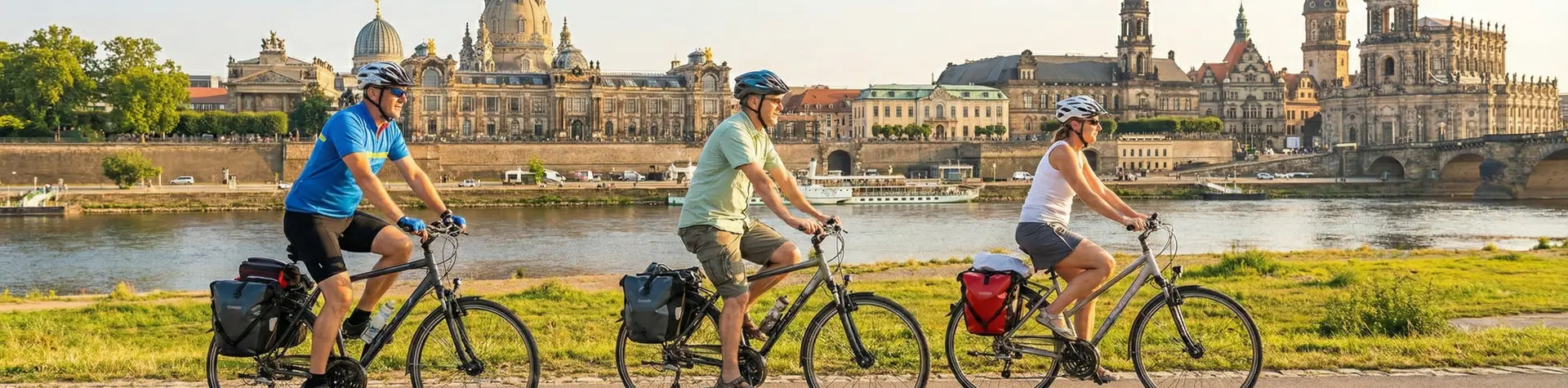
The Quick Answer
For seniors considering a first — or fifth — bike tour, the formula is straightforward: flat route + e-bike + luggage transfer. An e-bike eliminates the fear of not being fit enough, luggage transfer removes the weight from your bike, and a flat river route like the Danube means you're spending your energy on enjoying the scenery rather than grinding up hills. Seniors in their 60s and 70s regularly complete the Vienna to Budapest Danube route without it feeling like a physical challenge — it feels like a holiday.
Who This Guide Is For
This guide is written for:
- Active retirees who want a meaningful physical holiday but not an extreme one
- People in the 55–75 age range considering their first organised cycling trip
- Those with mild joint concerns — knees, hips — wondering whether cycling is appropriate
- Couples where one partner is more active than the other, looking for a trip both can enjoy
- Solo senior travellers looking for a structured, safe holiday with a clear framework
Why Cycling Holidays Suit Seniors
Cycling is one of the most joint-friendly forms of sustained exercise available. Unlike running or hiking, the saddle takes a significant portion of your body weight, and the circular pedalling motion is low-impact on knees and hips. Many physiotherapists recommend cycling specifically for people managing early-stage arthritis or recovering from joint procedures.
Beyond the physical profile, a bike tour suits the senior traveller's preferences in several other ways:
- Flexible pace: On a self-guided tour, you set the speed. There's no group to keep up with, no guide setting a demanding tempo. You ride at the speed that feels right.
- Genuine immersion: Unlike a coach tour or cruise, cycling puts you in the landscape rather than viewing it through a window. You smell the riverside air, hear the church bells, stop at the market stall that catches your eye.
- Structured independence: Hotels are booked, luggage is transferred, routes are mapped. But within that structure, each day is yours to manage as you choose.
- Social opportunity: On organised tours, you'll often share evening meals or morning breakfasts with other cyclists. For solo travellers especially, this built-in social structure is valuable.
E-Bikes: The Game Changer for Senior Cyclists
If there's a single development that has opened cycle tourism to a wider senior audience, it's the modern pedal-assist e-bike. These are not mopeds — you still pedal, and the cycling experience is real. The electric motor simply amplifies your effort, providing assistance proportional to how hard you're pedalling.
The practical impact is significant:
- A 50km stage that might be genuinely hard on a standard bike becomes comfortable on an e-bike
- Headwinds — the cyclist's least favourite weather — become a minor inconvenience rather than an exhausting battle
- The rare inclines on otherwise flat routes are handled without stress on knees or cardiovascular system
- You arrive at your hotel having enjoyed the ride, rather than having survived it
E-bikes do require charging overnight — your hotel will accommodate this — and they are heavier than standard bikes, which matters if you need to lift them. Most e-bike rentals on organised tours include handlebar-mounted display units showing battery level, speed, and distance, which most riders find intuitive within the first hour.
Battery range on modern e-bikes is typically 60–100km on a single charge at moderate assist levels — comfortably covering a 35–50km touring stage with reserve remaining.
Best Routes for Senior Cyclists
Danube Cycle Path — Vienna to Budapest
This is the benchmark route for senior cyclists in Central Europe. The Danube Valley between Vienna and Budapest offers approximately 300km of almost entirely flat cycling on dedicated paths, through the Wachau Valley UNESCO World Heritage landscape, Hungarian countryside, and the Danube Bend. Daily stages average 35–50km depending on the pace you choose.
The infrastructure along this route is excellent — regular towns with cafés and pharmacies, well-maintained cycle paths, and a high density of quality guesthouses and hotels. For seniors, the practical support network matters, and the Danube Danube route delivers it.
Danube Cycle Path — Passau to Vienna
The Passau to Vienna section of the Danube route is arguably even more scenic than Vienna to Budapest, passing through the spectacular Wachau Gorge and the monastery town of Melk. It's slightly shorter at around 300km over 6–7 days, making daily averages very manageable. This section is extremely popular with senior cyclists and is correspondingly well-served by tourism infrastructure.
Prague to Vienna
The Prague to Vienna route offers more variety — both in scenery and terrain — than a pure river route. While still suitable for seniors, especially with e-bikes, it includes more rolling sections than the flat Danube stages. Daily distances can be kept at 35–45km. For seniors who want a sense of journey between two iconic capital cities without the pure flatness of the Danube, this is the natural choice.
Daily Distances That Work
| Cycling Setup | Recommended Daily Distance | Time in Saddle |
|---|---|---|
| Standard bike, good fitness | 35–55km | 2.5–4 hours |
| E-bike, moderate fitness | 40–65km | 3–4.5 hours |
| E-bike, relaxed pace | 25–40km | 2–3 hours |
The key insight is that with an e-bike, you can cover slightly more distance with less fatigue — but there's no obligation to. Many senior cyclists on e-bikes choose to ride the same distances they'd ride on a standard bike, simply arriving in better condition. Both approaches are valid.
Accommodation and Comfort
Quality accommodation is not a luxury consideration for senior cyclists — it's a recovery tool. After 40km in the saddle, a comfortable bed, a proper shower, and a hot meal determine how well you feel the following morning.
Look for tours that offer:
- 3-star hotels or quality guesthouses as the baseline accommodation standard
- Private en-suite rooms (not shared facilities)
- Breakfast included — starting a cycling day properly fuelled matters
- Bike storage — a secure overnight space for your rental bike
- Ground floor or lift access if stairs are a concern
Most specialist cycle tour operators in Central Europe offer accommodation graded from comfortable to premium. For seniors, the middle tier — solid 3-star hotels with good beds and reliable hot water — typically provides the best value. Ultra-budget accommodation that compromises sleep quality is a false economy over a 7-day trip.
Health Considerations
Cycling is generally very well tolerated by people managing common age-related health conditions, but some specific considerations are worth noting.
Heart Conditions
If you have a diagnosed cardiac condition, speak to your GP or cardiologist before any sustained exercise holiday. This applies to cycling as it does to any other activity. Most people with well-managed cardiac conditions cycle regularly without issue; the point is to have a qualified opinion specific to your situation. An e-bike, which reduces peak cardiovascular effort, is often the appropriate choice.
Joint Issues
Cycling is low impact by nature, but saddle height matters significantly for knee health. A saddle set too low forces the knee through an excessively bent position under load, which can aggravate existing knee problems. When collecting your rental bike, ensure the saddle is set so your leg is nearly straight (a slight bend) at the bottom of the pedal stroke. Most rental shops will adjust this for you — ask.
Medication
Carry sufficient medication for your trip duration plus a buffer, and keep it in your daypack rather than in transferred luggage. Bring a basic summary of your medications in case of need for local medical assistance.
Practical Tips for Senior Cyclists
Book an E-Bike Early
E-bike availability at rental points on popular routes is limited and books up weeks or months in advance in peak season. If you're travelling in June, July, or August, secure your e-bike rental when you book the tour, not when you arrive.
Start Easy
Resist the temptation to prove yourself on day one. The Danube route will still be there — ride the first stage at a relaxed pace, stop frequently, and arrive comfortably. The riders who have the best time are usually those who treat the first two days as acclimatisation rather than performance.
Build in Afternoon Rest Stops
Plan to stop somewhere pleasant around the 25–30km mark each day. A long lunch at a riverside restaurant or a coffee in a town square is not wasted time — it's the point of the trip, and it breaks the day into two manageable halves.
Chamois Cream
If you're new to multi-day cycling, chamois cream applied to the pad of your cycling shorts before each ride significantly reduces saddle soreness. It's available at any cycling shop and costs very little. Do not skip this if you find day two uncomfortable.
Travel Insurance
Ensure your travel insurance covers cycling activities and includes medical evacuation coverage. Most standard policies do, but it's worth confirming. Some specialist cycle tour operators offer their own trip protection add-ons.
Recommended Tours for Seniors
The ideal senior-friendly tour combines:
- A flat or low-gradient route (Danube is the benchmark)
- E-bike rental as an available option
- Daily luggage transfer included
- Hotel accommodation with private en-suite rooms
- Self-guided format with detailed route notes (no fixed group pace)
- Responsive support contact in case of mechanical problems or health concerns
The Vienna to Budapest and Passau to Vienna Danube routes offered by specialist Central European cycle tour operators are the most popular choices among senior cyclists, and they consistently receive the highest satisfaction ratings from this age group. The routes work, the infrastructure is in place, and the experience has been refined by decades of operators learning what senior cyclists actually need.
A bike tour is not a young person's holiday with older participants awkwardly managing. Done well — flat route, e-bike, quality hotels, sensible distances — it is one of the finest holidays available at any age.