

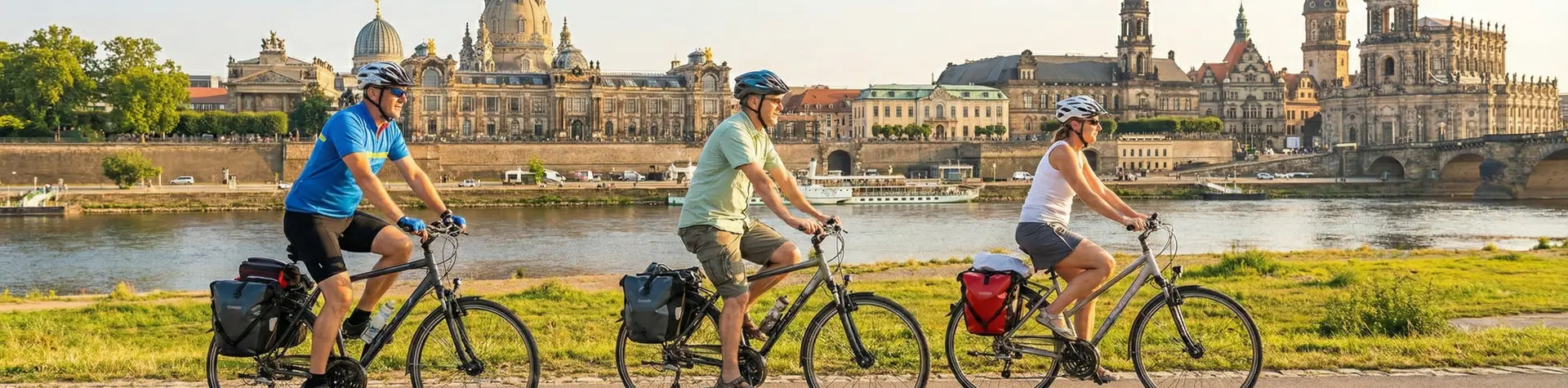
The Quick Answer
Choose a point-to-point tour if you want a sense of journey, progressive exploration, and the particular satisfaction of arriving somewhere new each day. Choose a one-base tour if you prefer to unpack once, explore a region without packing discipline, and enjoy a relaxed return to familiar surroundings each evening. For most cyclists who want the quintessential cycling holiday experience — particularly on iconic river routes like the Danube — point-to-point is the more natural and rewarding choice.
Who This Guide Is For
This guide is written for:
- First-time cycle tourists deciding which tour format makes more sense to start with
- Experienced cyclists considering a different format from what they've done before
- Families thinking about logistics and whether one-base simplicity suits their group
- Couples or solo travellers weighing up the social and experiential differences
What Is a One-Base Tour?
A one-base tour (also called a hub-and-spoke tour) places you at a single accommodation — usually a hotel, guesthouse, or even a holiday apartment — for the duration of your trip. Each morning you ride out on a different route, exploring the surrounding region, and each evening you return to the same base.
Key characteristics:
- You unpack once and live out of your room for the full trip
- Daily rides are loop-based — you start and end in the same place
- No luggage transfer is required (your bags stay in your room)
- You get to know a single town or area in depth
- Routes vary each day, but the base is always familiar
One-base tours are common in cycling regions with a dense network of day-ride options from a central point — wine regions, national parks, or cities with good cycling infrastructure in all directions.
What Is a Point-to-Point Tour?
A point-to-point tour (sometimes called a linear tour) moves you progressively from one destination to the next. Each day you cycle to a new town, check into a different hotel, and continue onward the following morning. Your luggage travels by transfer van to each successive destination.
Key characteristics:
- A new destination — often a new town or village — every day
- Luggage transfer handles your main bags each morning
- The route has a clear start and finish point (e.g. Vienna to Budapest)
- The journey itself becomes the narrative of the trip
- You carry only a small daypack while cycling
Point-to-point tours are the natural format for long-distance river routes — the Danube, Elbe, Rhine — where following the river logically takes you from one significant place to another.
Comparison: One-Base vs Point-to-Point
| Factor | One-Base | Point-to-Point |
|---|---|---|
| Packing | Unpack once, done | Pack lightly every morning |
| Luggage logistics | None (bags stay in room) | Requires daily transfer coordination |
| Navigation | Return to base — no pressure | One-directional — must reach next stop |
| Sense of journey | Exploratory but familiar | Progressive and complete |
| Variety of scenery | Good (day loops in different directions) | Excellent (new landscapes daily) |
| Rest day flexibility | Easy — just stay at base | Requires schedule adjustment |
| Town exploration | Deep knowledge of one town | Brief but repeated exposure to many towns |
| Best for | Families, those who hate packing | Most cyclists wanting the touring experience |
Pros of a One-Base Tour
Unpack Once
The logistics of packing your bags every morning and ensuring nothing is left behind is eliminated entirely. For some travellers — particularly families with children, or those who find the admin of daily packing stressful — this is a significant quality-of-life advantage. Your room becomes a comfortable home base for the week.
Deeper Local Knowledge
Spending a week in one town means you discover the best coffee shop on day two, the good evening restaurant on day three, and the quiet corner of the market on day five. Repeated exposure to a single place builds familiarity that a one-night stop on a point-to-point tour never can.
No Minimum Daily Distance
On a point-to-point tour, you generally need to reach the next hotel — even if it means riding in bad weather or when you don't feel great. On a one-base tour, if the weather is poor or you want a rest day, you simply don't ride. There's no hotel to reach, no transfer van to catch up with.
Good for Groups with Varied Fitness
In a group with significantly different fitness levels, one-base tours allow faster cyclists to do longer loops while slower cyclists do shorter ones — everyone returns to the same place, and the day's routing is independently chosen.
Cons of a One-Base Tour
The Base Town Can Feel Repetitive
If your base is a small or unremarkable town, returning to the same place every evening for seven days can feel limiting. One-base tours work best when the base town itself is somewhere you genuinely want to spend time.
Less Sense of Journey
For many cyclists, the defining pleasure of cycle touring is the sense of moving through a landscape, watching it change day by day. A one-base tour provides exploration but not progression. If the journey itself is what you're after, a one-base tour delivers a lesser version of it.
Return Legs
Loop routes require returning to your starting point. This means either retracing part of your outbound route — which can feel repetitive — or finding circular routes that don't always follow the most scenic or logical path.
Pros of a Point-to-Point Tour
Progressive Journey
The point-to-point format delivers the most satisfying version of the cycle touring experience: a journey with a beginning, middle, and end. You leave Vienna and arrive in Budapest. You leave Prague and arrive in Vienna. The distance covered accumulates into a tangible achievement with a clear geographic narrative.
Maximum Scenic Variety
On a river route like the Danube, each day reveals genuinely new landscapes, new towns, and new river scenery. The Wachau Valley on day three looks nothing like the Hungarian lowlands on day seven. This variety is one of the core pleasures of the format.
The Iconic Routes Are Point-to-Point
EuroVelo 6, the Danube Cycle Path, the Elbe Cycle Path — the benchmark European cycle routes are linear, not circular. Following them in their intended direction, stopping in the towns along the way, is the classic touring experience. Point-to-point is not a feature of these routes; it is the routes.
Cons of a Point-to-Point Tour
Packing Discipline Required
Every morning, you pack your main bags for transfer and your daypack for riding. Forgetting something in your hotel room is a problem — it may not be retrieved until the end of the trip. The discipline of checking rooms before checkout, every day, is a real requirement of the format.
More Logistics
Luggage transfer, hotel check-ins at different locations, navigation to a specific destination each day — point-to-point tours have more moving parts than one-base. The best tour operators handle most of this, but the cyclist still needs to be organised and attentive to daily instructions.
Which Format Suits Which Traveller
| Traveller Type | Recommended Format | Reason |
|---|---|---|
| First-time cycle tourist | Point-to-point | The benchmark experience; iconic routes are linear |
| Family with children | One-base | Simpler logistics, no daily packing stress |
| Couple wanting romance | Point-to-point | New towns each evening, progressive journey narrative |
| Solo traveller | Point-to-point | Best social opportunities on organised tours |
| Group with mixed fitness | One-base | Independent daily routing, no fixed destination pressure |
| Cyclist wanting challenge | Point-to-point | Long-distance achievement, high-variety routes |
Practical Tips
For Point-to-Point Tours
- Label everything in your transfer bag with your name and tour reference. Bags from multiple groups travel on the same transfer vans on busy routes.
- Check every drawer and socket before leaving each hotel. Phone chargers are the most commonly forgotten item on cycle tours.
- Pack a small recovery kit in your daypack — phone charger, change of inner tube, basic medication — in case your transfer bag is delayed.
For One-Base Tours
- Choose your base town carefully. A week in a genuinely interesting place — a wine town, a riverside city, a market town — makes the one-base format sing. A week in a transit town does not.
- Plan routes in advance to avoid covering the same ground repeatedly. Most one-base tour operators provide a set of suggested day routes in different directions.
- Use rest days properly. The flexibility to not ride is a genuine advantage — use it to explore your base town on foot, visit a museum, or simply sit in a café for a morning.
Recommended Tours
For the point-to-point experience, the Danube cycle path from Vienna to Budapest or Prague to Vienna are the benchmark choices for Central Europe. These routes are designed for the linear format, with daily stages that progress naturally between interesting destinations, excellent luggage transfer infrastructure, and the iconic river scenery that makes the format work.
For the one-base experience, wine regions with dense cycle path networks — the Wachau in Austria, or lake regions in Slovakia and Hungary — provide the best variety of day loops from a single comfortable base.
Most cyclists who try both formats ultimately prefer point-to-point for the sense of achievement and variety it delivers. But the one-base format earns its place for the right traveller in the right location — and for some, it's the better holiday.