Quick answer
If you can comfortably ride a bike for 2–3 hours without stopping, you're likely ready for a self-guided bike tour on a flat river route. Most of our tours cover 40–70 km per day on paved or gravel cycle paths with very little climbing. E-bikes remove the fitness barrier almost entirely.
Who is this for
This guide is for anyone who hasn't cycled seriously in a while and is wondering whether a week-long bike holiday is within reach — couples in their 40s and 50s, families with older children, solo travellers, or anyone who cycles occasionally but has never done back-to-back riding days.
The honest fitness bar for flat river tours
Our Central European routes — the Prague to Vienna corridor, the Danube Cycle Path, and the Elbe Cycle Path — were built for recreational cycling. The terrain is mostly flat with occasional gentle hills. There are no mountain passes, no technical descents, and no mandatory steep climbs.
A realistic self-assessment: if you can ride 20–25 km in one go without feeling destroyed, and your legs recover overnight, you can handle 50–60 km days on a flat route with breaks. If that still sounds like a lot, consider:
- Choosing a shorter stage option (most routes offer 40 km or 60 km variants per day)
- Booking an e-bike, which cuts perceived effort by 30–50%
- Adding a rest day mid-tour
What 50 km per day actually feels like
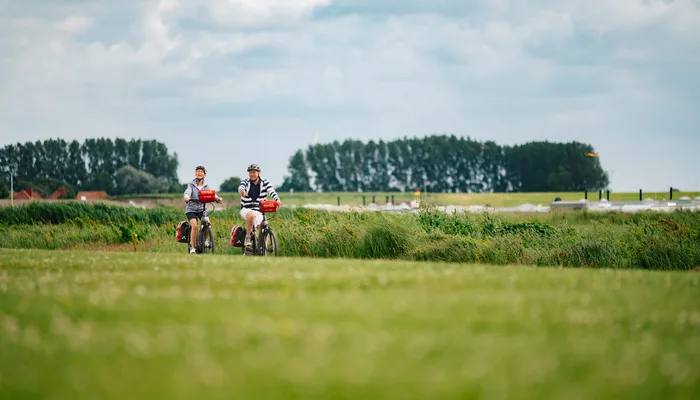
On a flat, signposted cycle path with a touring bike or e-bike, 50 km takes roughly 3–4 hours of riding time. Most cyclists split this into a morning ride, a lunch stop, and an afternoon stretch. You're not racing — you're sightseeing on two wheels.
Compare this to walking: 50 km would take 10+ hours on foot. On a bike, the same distance is a relaxed day out. The challenge isn't raw fitness — it's saddle comfort and consistency over multiple days.
The multi-day factor: why consecutive days matter more than daily distance
The biggest adjustment for new touring cyclists is that you ride on tired legs. Day 1 feels easy. Day 3 or 4 is where most people hit a wall — not because the distance increased, but because fatigue accumulates.
This is why training matters even for fit people. If your preparation consists of one long ride per week, you're not training the right thing. You need to practice back-to-back riding days, even if they're short (20–30 km each). Two or three consecutive riding days before your tour will tell you far more about your readiness than a single 80 km ride.
Fitness levels: which category are you?
| Level | Background | Recommended tour type |
|---|---|---|
| Beginner | Cycles occasionally, not regularly. Last ride was months ago. | Flat e-bike tour, 40–50 km stages, 5–6 days |
| Recreational | Cycles 1–2× per week, comfortable for 2 hours. No touring experience. | Flat route on regular bike, 50–60 km stages |
| Active | Regular cyclist, commutes or weekend rides 50+ km. Occasional hills. | Any flat or rolling route, 60–80 km stages |
| Sporty | Fitness cyclist, road or gravel experience, comfortable in the saddle all day. | All routes including hilly variants, 80+ km stages |
Does weight matter?
On flat terrain, body weight has relatively little impact on cycling effort. Hills are where it becomes noticeable. Since our routes are predominantly flat, weight is far less of a factor than it would be on an alpine cycling holiday. The bigger variables are cardiovascular fitness (can you sustain moderate effort for 3–4 hours?) and muscular endurance in your legs (do your quads and glutes recover overnight?).
E-bikes as a fitness equaliser
An e-bike with pedal assist doesn't do the work for you — it multiplies your effort. If you push lightly, it pushes back proportionally. This means you still get exercise, but you don't bonk on day 4. For cyclists who are fit but worry about keeping up with a partner, recovering from injury, or simply want to enjoy the scenery without suffering, an e-bike is the right tool.
On our flat river routes, a standard e-bike will handle 60–80 km per charge without any anxiety. Charging happens overnight at your hotel. There is no downside to choosing an e-bike on these routes.
What about hills?
Most of our featured tours have very low total elevation gain per day — typically under 500 m. For context: a 500 m day on a river route means you crossed one or two gentle ridges, not that you climbed a mountain. If you see a day with 800–1000 m of elevation listed, that route has a hilly section worth checking before booking.
For a full explanation of what elevation numbers mean in practice, see our guide on Elevation Explained for Cyclists.
Practical tips
- Do at least 3 consecutive riding days before your tour — even 25–30 km each is enough to find saddle sore spots and adjust your bike fit
- Get your saddle height right — most knee pain on tours comes from a saddle that's too low
- Invest in padded shorts — this is not negotiable for multi-day riding
- Eat before you're hungry, drink before you're thirsty — bonking (running out of energy) is the main cause of miserable afternoons on tours
- Start easy on day 1 — resist the temptation to overdo it on the first day when your legs feel fresh
- Book luggage transfer — riding without a heavy pack dramatically lowers the fitness bar
Recommended tours
If you're new to bike touring or returning after a long break, the Danube Cycle Path (Passau to Vienna) and the Prague to Vienna route via the Greenways are both excellent starting points — flat, well-serviced, and forgiving for beginners. Both are also available with e-bike upgrades.